Recently, the AFRO highlighted Governor Wes Moore’s work to “secure victories for Black candidates across the state and nation.”
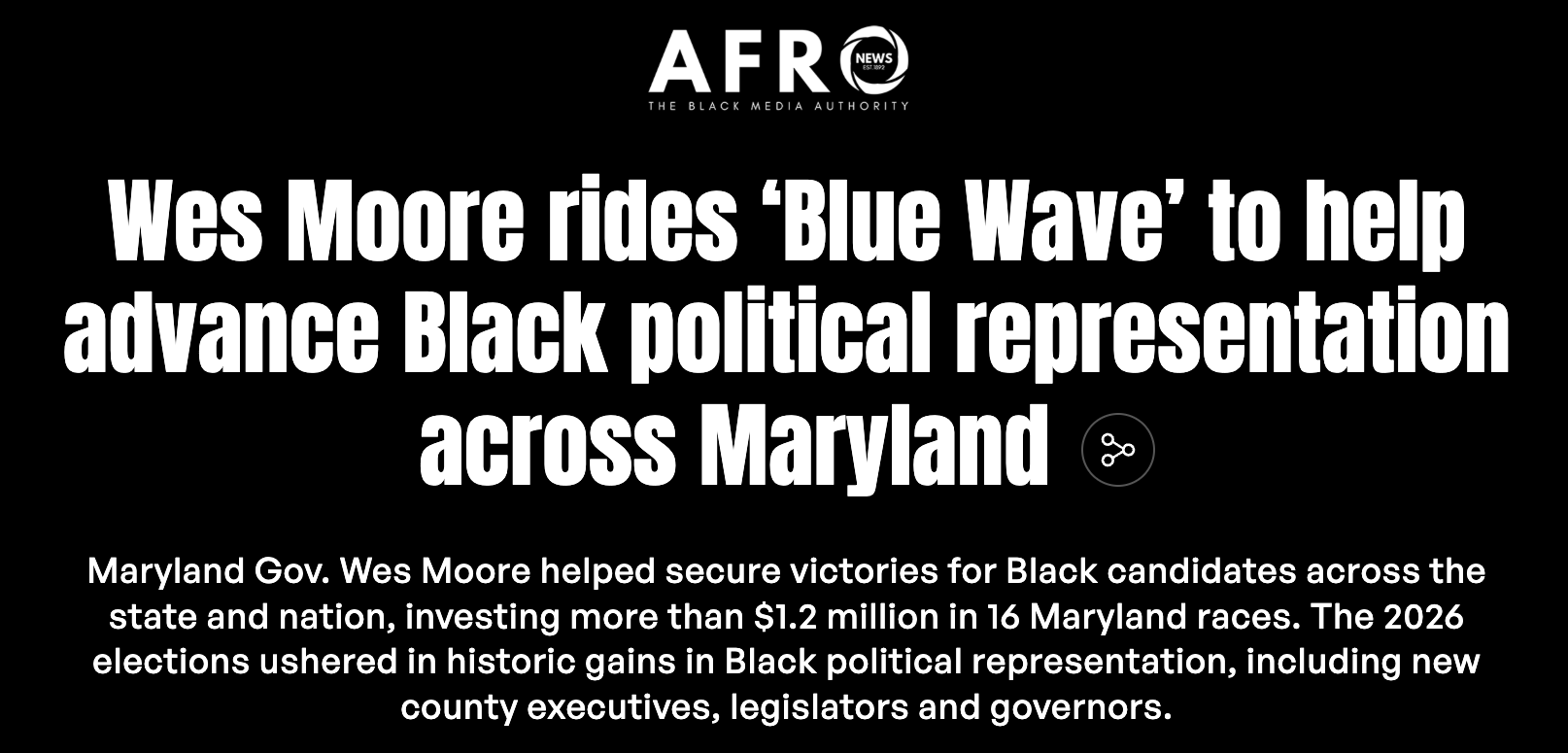
“Maryland Gov. Wes Moore helped secure victories for Black candidates across the state and nation, investing more than $1.2 million in 16 Maryland races,” said Alexis Taylor, Managing Editor of the AFRO. “The 2026 elections ushered in historic gains in Black political representation, including new county executives, legislators and governors.”
Here’s What Marylanders Are Reading:
Maryland Gov. Wes Moore was never content with being the only Black governor in the room.
When the people of Maryland chose him to lead their state in 2022 he was only the third Black man in the country to ever be elected to serve as a governor. On Jan. 18, 2023, he was sworn in, carrying the added weight and responsibility of being “the Black governor.”
“I don’t want that title, nor do I want anyone to ever have that title again,” said Moore, in an AFRO News interview. “It was indicting that that was even a thing. When you consider the 250-year history of this country, and you consider the remarkable African-American political leadership that we’ve seen, the fact that I was only third to ever be elected was still just a staggering fact to me.”
As a result of the 2026 midterm elections, Moore will finally shed the unwanted title. In 2027, he, along with five other Black leaders, will be sworn in to serve as governors across the United States and its territories.
When Georgia’s Gov.-elect Keisha Lance Bottoms steps into office she will do so as the first Black woman in the country to serve as a governor. Gov.-elect Aaron Ford in Nevada and David Crowley in Wisconsin are the first Black governors in their respective states. And Byron Donalds, who ran on the Republican ticket, will be the first Black man to lead the state of Florida.
“I was very intentional. We were going down into Georgia to campaign for Keisha Lance Bottoms. We were going to Wisconsin and campaign for David Crowley. We were going to Nevada to campaign for Aaron Ford,” said Moore.
He noted that in January 2027, 10 percent of the nation’s governors will be Black.
“It does usher in a powerful new moment in American political power,” said Moore, who is the current chair of the National Governors Association.
In the U.S. Virgin Islands, Stacey Plaskett will be the first woman to represent the country as governor. She previously served the U.S. territory as a non-voting representative in Congress for more than a decade.
While a “Blue Wave” and “Black Tsunami” clearly washed over the country on Election Day, the results have less to do with luck, and much more to do with the careful planning and investments made by leaders looking to usher in the future.
In Maryland, Gov. Moore hit the campaign trail for candidates in a variety of races. According to information sent to AFRO News from Moore’s communications team, more than $1.2 million was used to help candidates succeed in 16 different races. Notably, the investment helped a number of Black leaders cross the finish line.
Adrian Boafo was polling in the single digits when he gained the governor’s support. Next year, Boafo will begin representing Maryland’s 5th Congressional District in place of Rep. Steny Hoyer (D), who announced plans to retire at the end of his term in January. Boafo won his race with 70.2 percent of the votes, according to unofficial ballot results refreshed on Nov. 13.
A total of five Black men and women will also serve as sheriffs across Maryland. The midterm elections also yielded the first Black woman on the Baltimore County Council, Makeda Scott.
In St. Mary’s County, where 2025 Census estimates reported a white population of 73.7 percent and a Black population of 15.9 percent, residents elected their first Black legislator. Adrianne Mathis will make history for the county when she is sworn into the Maryland General Assembly next year.
Though many “firsts” came out of the midterm elections, Moore said his focus was on people who understood that “making history wasn’t the assignment.” The governor said he needed the successful candidates to be people willing to do the work to make issues like child poverty and income inequality history.
In the county executive races, Will Jawando will soon represent Montgomery County. Vanessa Atterbeary will be the first Black woman to take on the role in Howard County. Ernest Davis, of Wicomico County, and Julian Jones, in Baltimore County, were also successful in their races.
Davis and Jones are the first Black people to represent their counties as executive.
Jones said he was appreciative of the support from other leaders like Moore, and looks forward to the work they will get done together.
“He and I have supported each other over the years, and I am extremely humbled by his support,” said Jones. “I think the governor looked at the people running in this race and concluded that I was by far the most qualified person to lead Baltimore County at this time, and that’s the way I presented myself throughout this campaign.”
Jones said he is “confident” that he and Moore will have “a great working relationship.”
“There are tremendous challenges that are facing Baltimore County as well as the state of Maryland,” Jones told the AFRO. “And I just think we can do a lot more when we work together.”